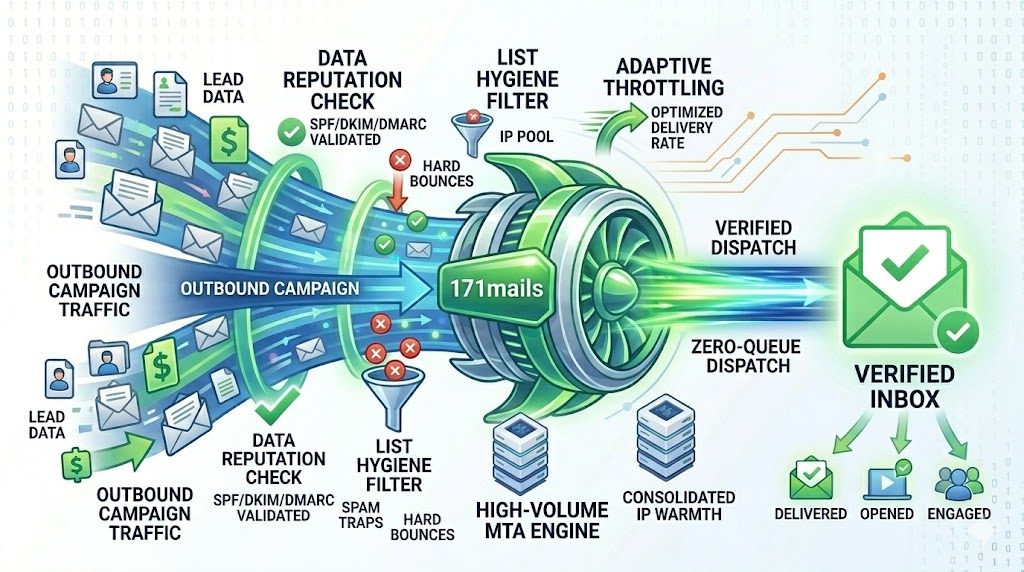

In the early 2000s, you could point a mail server at a list and “spray and pray.” Today, the “Big Three”—Google, Yahoo, and Microsoft—employ AI-driven guardians that analyze the “velocity,” “volume,” and “engagement” of your traffic in real-time. If you hit their gateways too hard, too fast, or with inconsistent patterns, your infrastructure will be throttled, or worse, permanently blacklisted.
To succeed at scale, you must move beyond simple “sending” and start “orchestrating.” This guide breaks down the professional architecture required to manage 1-million-plus daily sends on 171mails.
1. The Geometry of Throughput: Connections vs. Messages
The most common mistake high-volume senders make is confusing speed with concurrency.
When you send 1 million emails, you aren’t just sending one big file. You are opening thousands of individual “conversations” with receiving servers.
-
Concurrent Connections: This is how many “doors” you open at once to a specific ISP (e.g., Gmail).
-
Messages Per Connection: This is how many emails you “hand over” before closing that door.
If you open too many connections simultaneously, ISPs see it as a Denial of Service (DoS) attack. A professional smtp relay for marketing emails like 171mails allows you to fine-tune these parameters. For high-volume success, you should aim for a “Steady State” flow rather than a “Burst” flow.
2. IP Rotation vs. Warmth Consistency
In the veteran community, we often hear about “IP Rotation” as a way to hide from filters. In 2026, IP Rotation is a red flag. Modern AI filters look for “Snowshoeing”—the act of spreading spam across many IPs to dilute the “reputation hit.” Instead of rotating, you should focus on Volume Consolidation. By sending consistently from a dedicated pool of IPs, you build a “High-Trust History.”
If you need to send 1 million emails, don’t use 100 cold IPs. Use 5-10 “blazing hot” IPs that have been seasoned with consistent engagement. This is the secret to staying in the Primary Tab.
3. The “Creative Footprint”: HTML vs. Text Ratios
High-volume filters don’t just look at your IP; they “fingerprint” your creative content. If you send 1 million identical emails, you create a massive “footprint.”
-
Hash Busting: Use dynamic tags to ensure that every email has slight variations in the HTML code.
-
Link Hygiene: In email marketing for affiliates, link shorteners like Bitly are “deliverability poison.” They are used by millions of spammers, meaning their domains are almost always on a “Watchlist.” Use Branded Tracking Links that match your sending domain.
4. Adaptive Throttling: Playing by the ISP’s Rules
Every ISP has a different “tolerance” for volume.
-
Gmail might allow 5,000 emails per hour on a warm IP.
-
Outlook might throttle you after 2,000 if your engagement is low.
A professional strategy involves Adaptive Throttling. Your MTA should monitor “Deferred” messages in real-time. If an ISP says “421 – Too many connections,” your system must automatically “back off” for 15 minutes. This “politeness” is a massive trust signal. At 171mails, our infrastructure handles this “Back-off Logic” automatically, protecting your sender score while you sleep.
5. The “Engagement Trap”: Why List Cleaning is Part of Strategy
You cannot send 1 million emails to a “dirty” list. If your bounce rate exceeds 2%, or your spam complaint rate exceeds 0.1%, your high-volume campaign will be killed mid-send.
-
Real-time Suppression: Before a high-volume blast, run your list through a verification service.
-
Feedback Loops (FBL): Ensure your FBLs are active. The moment a user clicks “Spam,” they must be removed from your active sending queue in milliseconds.
6. Conclusion: Scaling with Precision
High-volume sending is a game of marginal gains. A 1% increase in inbox placement on a million-send campaign results in 10,000 extra eyes on your offer.
By mastering the physics of connections, maintaining a consistent IP footprint, and utilizing adaptive throttling on 171mails, you transform your email marketing from a “chance-based” activity into a high-performance revenue engine.