
In the current digital economy, there are two types of agencies: those that rent their infrastructure and those that own it.
If you are currently paying a “per-subscriber” fee to a major ESP, you are essentially paying a tax on your own growth. For a high-volume agency, that tax can be the difference between a 10% margin and a 70% margin. The most successful lead-gen firms in 2026 have moved beyond the “service” model and into the Infrastructure Model. By pairing the multi-tenant power of MailWizz with the dedicated horsepower of 171mails, you can build a white-labeled “Email SaaS” that functions like your own private Mailchimp—minus the restrictions, the high costs, and the risk of sudden de-platforming.
1. The Multi-Tenant Architecture: Becoming the Provider
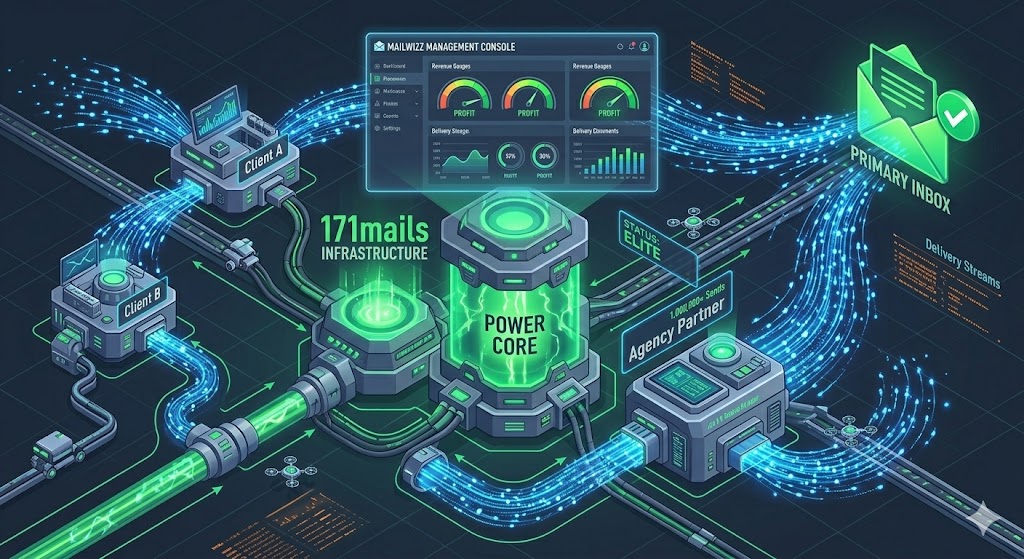
MailWizz is not just an email sender; it is a Customer Management System (CMS) for infrastructure. Its true power lies in its “Customer Groups” and “Sub-account” architecture, which allows for total isolation between different sending entities.
-
The Strategy: You set up a master MailWizz instance on a high-performance VPS and connect it to your dedicated 171mails SMTP Nodes.
-
The Revenue: You create sub-accounts for your clients. They log into your branded dashboard, upload their lists, and send their campaigns. You are no longer just “running a campaign” for them; you are providing the critical platform they rely on for their daily operations. This shifts your value proposition from a “service provider” to a “technology partner.”
2. Quota Management: The Secret to Scalable Profit
In a SaaS model, you monetize the “Gap.” You buy wholesale sending power from 171mails and retail it to your clients through MailWizz’s granular quota system. This is where you control your margins.
-
The Control: MailWizz allows you to set specific limits per customer group. You can define: “Client A gets 500k sends per month with 5 dedicated IPs.” “Client B (the high-roller) gets 5M sends and a high-priority 171mails API relay.”
-
The Optimization: Because you are using 171mails’ dedicated infrastructure, you can guarantee deliverability that “off-the-shelf” ESPs can’t touch. You are selling Certainty, which is the highest-value product in the email world. By managing the volume at the software level, you ensure your server resources are never over-extended.
3. Protecting the “Master Node”: Customer Reputation Tracking
The biggest fear for any infrastructure owner is a “Bad Client” burning a clean IP. In a shared ESP environment, if one user gets blocked, the whole pool suffers. MailWizz solves this with Internal Reputation Scoring.
As an agency owner, you can set automatic thresholds. If a client’s campaign generates a bounce rate over 3% or a complaint rate over 0.1%, MailWizz can automatically “Pause” their sending and alert your team. This “Internal Police” protects your master 171mails IP reputation. You can effectively “fire” a bad client before they damage the “Institutional Trust” you’ve built with Gmail or Yahoo.
4. Total Brand Sovereignty (The White-Label Edge)
Clients stay where they feel they are part of something exclusive and professional. With MailWizz, every touchpoint—from the login screen and the “Unsubscribe” link to the tracking domains—is branded to your agency.
When combined with 171mails’ custom rDNS and PTR capabilities, the technical “fingerprint” of the email points entirely to your brand. To the receiving ISPs, you are the Mailchimp. You are the Salesforce. This level of technical authority allows you to command higher prices and build a “Moat” around your clients that competitors sending from generic shared relays simply cannot cross.