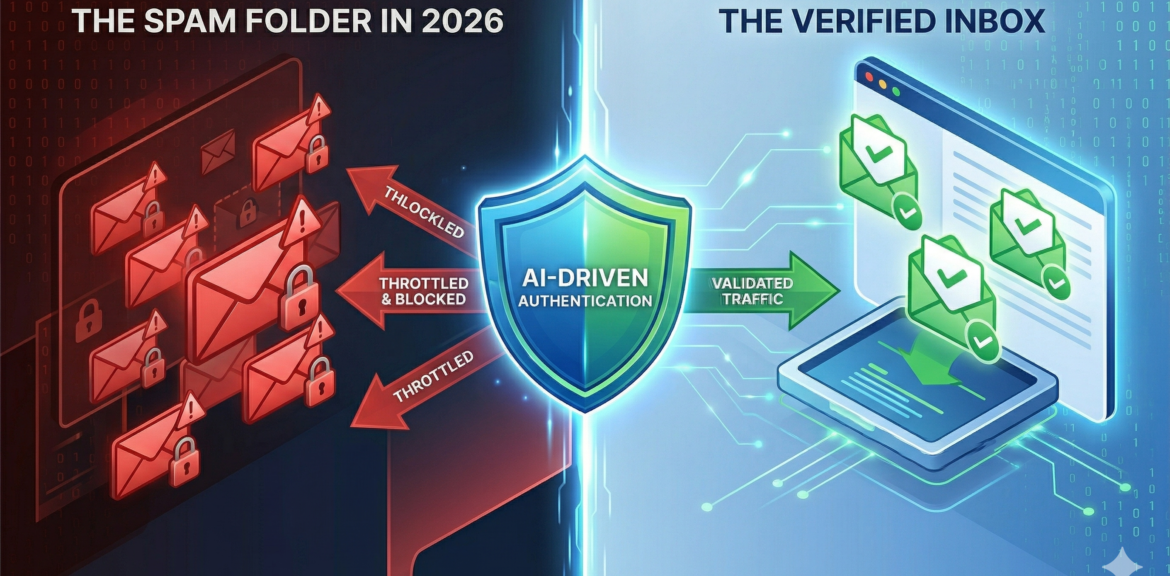

The digital landscape has shifted. In 2026, the gatekeepers of the inbox—Gmail, Yahoo, and Outlook—have deployed sophisticated AI-driven algorithms that go far beyond simple keyword filtering. For anyone involved in digital outreach, especially those navigating email marketing for affiliates, the challenge is no longer just about sending mail; it is about proving you belong in the recipient’s primary tab.
Landing in the spam folder is more than a minor inconvenience; it is a silent killer of ROI. When your messages are flagged, your sender reputation takes a hit, creating a downward spiral that is difficult to reverse. To stay ahead, you need a strategy rooted in technical precision and behavioral psychology.
The Evolution of Spam Filters
In the past, avoiding spam was about avoiding “trigger words” like free, win, or cash. While content still matters, 2026 filters focus heavily on Sender Identity and Engagement Metadata.
Modern filters look at “positive signals” (opens, replies, moving mail to folders) versus “negative signals” (deletions without opening, unsubscribes, and the dreaded “Report Spam” click). If you are using a standard web host to send high volumes, you are likely already at a disadvantage. Professional senders now rely on a dedicated smtp relay for marketing emails to ensure their infrastructure is optimized for these AI guardians.
Phase 1: The Technical Foundation (Authentication)
Before you send a single word of copy, your “digital passport” must be in order. Without proper authentication, major ISPs will treat your mail as a security risk.
1. SPF (Sender Policy Framework)
SPF is a DNS record that lists the specific IP addresses authorized to send mail on behalf of your domain. If an email arrives from an IP not on that list, it’s an immediate red flag.
2. DKIM (DomainKeys Identified Mail)
Think of DKIM as a digital seal on your envelope. It uses cryptographic signatures to prove that the email was actually sent by the domain owner and wasn’t intercepted or modified in transit.
3. DMARC (Domain-based Message Authentication, Reporting, and Conformance)
DMARC is the instruction manual you give to receiving servers. It tells them: “If an email fails SPF or DKIM, here is what you should do—nothing, quarantine it, or reject it entirely.” In 2026, having a “p=reject” or “p=quarantine” policy is nearly mandatory for high-volume senders to establish trust.
Phase 2: Infrastructure and Reputation
Your “sending neighborhood” determines how the world perceives you. This is particularly critical in the niche of email marketing for affiliates, where link-heavy content can sometimes be misinterpreted by filters.
The Power of a Dedicated SMTP Relay
Using a generic server is like sharing a credit score with 1,000 strangers. If one person defaults, everyone’s score drops. A dedicated smtp relay for marketing emails provides you with a clean, isolated IP address. This means your deliverability is governed solely by your actions, not the mistakes of others.
IP and Domain Warming
You cannot go from zero to 100,000 emails overnight. Sudden spikes in volume are a hallmark of botnets. “Warming” involve gradually increasing your daily send volume over 3-4 weeks. This allows ISP algorithms to observe your consistent engagement patterns and “whitelist” your traffic patterns.
Phase 3: List Hygiene and Behavioral Cues
In 2026, the size of your list is irrelevant if it is full of “ghost” subscribers.
1. Sunset Policies
If a subscriber hasn’t opened an email in 90 days, they are actively hurting your reputation. Every time you send to an inactive user, your “open rate percentage” drops, signaling to ISPs that your content is uninteresting. Implement an automated sunset policy to remove or re-engage these users.
2. The Trap of “Spam Traps”
Old, abandoned email addresses are often turned into “Spam Traps” by ISPs. If you send mail to one of these, it proves you aren’t using a “confirmed opt-in” process or haven’t cleaned your list in years. Regular list scrubbing is non-negotiable.
3. Facilitate the Exit
It sounds counterintuitive, but making the “Unsubscribe” button easy to find is a deliverability hack. If a user can’t find the unsubscribe link, they will click “Report Spam” instead. The former is a neutral signal; the latter is a catastrophic negative signal.
Phase 4: Content Strategy for 2026
While technicals get you through the door, content keeps you in the room.
-
Avoid Link Shorthand: Using generic bit.ly or tinyurl links is a common mistake in email marketing for affiliates. Spammers love these because they hide the final destination. Use branded, transparent links instead.
-
Balance the Image-to-Text Ratio: An email that is just one large image is a classic spam tactic. Ensure you have a healthy amount of HTML text to provide context to the filters.
-
Personalization Beyond the Name: AI filters now detect if “personalized” content is just a template. Aim for deep personalization based on past behavior or purchase history.
Conclusion: The Holistic Approach
Avoiding the spam folder in 2026 is an ongoing process of maintenance and adaptation. It requires a robust smtp relay for marketing emails to handle the technical heavy lifting and a commitment to quality content that respects the subscriber’s inbox.
By focusing on authentication, infrastructure isolation, and rigorous list hygiene, you can ensure that your email marketing for affiliates remains a high-performance engine for your business, landing where it matters most: right in front of your customers.